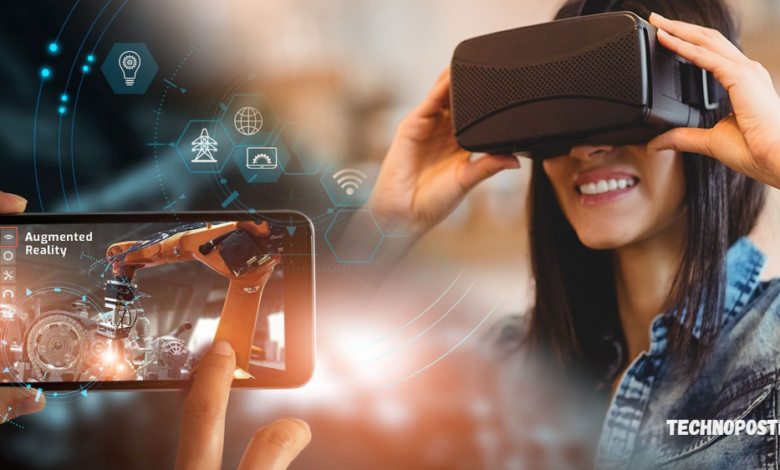
The advent of Augmented Reality (AR) and Virtual Reality (VR) marks a pivotal shift in how individuals engage with both their physical environment and digital experiences. These technologies are revolutionizing various industries, from education and entertainment to training and beyond, enhancing user interactions in unprecedented ways. However, as AR and VR continue to advance, they present both complex challenges and significant opportunities for innovation. Understanding their potential and implications is essential as we explore their broader impact on society and industry. The future of these transformative technologies promises to reshape the way we interact with the world, offering a glimpse into new dimensions of possibility and engagement.
Understanding Augmented Reality
Augmented Reality (AR) amplifies the user’s perception of the real world by seamlessly integrating digital elements, such as images, sounds, and data, into their immediate environment. This fusion of physical and virtual worlds enables a dynamic and interactive experience.
AR technology is transforming numerous industries, notably education and marketing, by offering immersive, engaging experiences that enhance learning and consumer engagement.
AR addresses key considerations such as safety, design principles, hardware requirements, and ensuring accessibility for all users, making it a versatile and inclusive tool for a wide range of applications.
What is Augmented Reality (AR)?
Augmented Reality (AR) enhances the user’s perception of the real world by overlaying digital content, such as images, sounds, or data, onto their physical surroundings. This blending of the virtual and physical worlds creates an interactive experience that enriches the user’s environment without replacing it. Unlike Virtual Reality (VR), which immerses the user in a completely simulated environment, AR works by enhancing what is already there.
The most popular examples of AR technology are applications such as Pokémon Go, where digital characters appear in real-world locations, and apps that allow users to visualize furniture or home decor items in their own living rooms before making a purchase. In both cases, AR blends virtual objects seamlessly into the user’s view of the world, offering a more interactive and engaging experience.
What is Virtual Reality (VR)?
Virtual Reality (VR), on the other hand, offers a fully immersive experience by transporting users into a wholly digital environment. With VR, users typically wear a headset that blocks out their physical surroundings, allowing them to engage with and navigate virtual worlds. This can range from interactive games and simulations to virtual tours of distant places, offering experiences that would be difficult or impossible to replicate in the real world.
VR has been especially popular in entertainment, gaming, and simulations, where users can engage in interactive, 3D environments. Additionally, VR has found applications in fields like healthcare, where it can be used for surgery simulations or patient treatment, and in education, where immersive environments allow for experiential learning.
Applications of AR and VR
Both AR and VR have significantly impacted various industries, creating new opportunities and reshaping existing practices.
1. Education and Training
AR and VR have revolutionized education by providing students with immersive and interactive learning experiences. In VR, students can explore historical landmarks, conduct scientific experiments, or participate in virtual field trips that would otherwise be inaccessible. AR enhances classroom learning by providing real-time data overlays or interactive visual aids, making complex concepts easier to understand.
In professional training, VR is widely used for simulations that allow individuals to practice skills in a risk-free environment. For instance, VR training is used in industries like aviation, healthcare, and military to simulate real-life scenarios, providing hands-on experience without the potential dangers.
2. Healthcare
In healthcare, both AR and VR are used for various applications. VR is often employed in therapeutic settings, such as helping patients with PTSD or phobias through controlled exposure to virtual environments. It is also used in surgical training, allowing medical professionals to practice procedures in a safe, virtual space.
AR is also transforming healthcare by offering surgeons real-time data and visualizations during operations. For example, AR can overlay critical information, such as 3D models of organs, onto a patient’s body, guiding the surgeon through complex procedures with enhanced precision.
3. Retail and Marketing
In retail, AR is transforming how customers interact with products. By using AR apps, consumers can visualize how furniture or clothing will look in their homes or on their bodies before making a purchase. Virtual fitting rooms, where customers try on clothes virtually, are also becoming more common, offering convenience and reducing the need for physical try-ons.
On the marketing front, AR is creating engaging experiences that allow brands to interact with consumers in innovative ways. Brands use AR to create interactive advertisements, enabling users to engage with products in a more meaningful way, whether through virtual try-ons, interactive billboards, or games that promote a product.
4. Entertainment and Gaming
Both AR and VR have had an undeniable impact on entertainment and gaming, offering immersive experiences that captivate users in ways traditional media cannot. In gaming, VR gives players a level of immersion and interaction that conventional video games can’t match, while AR has opened up new avenues for games that blend the real world with digital play.
In the entertainment industry, VR is used to create virtual concerts, theatrical performances, and even films, allowing audiences to be part of the action in a way that traditional media simply can’t replicate.
The Future of AR and VR
As AR and VR technologies continue to evolve, their impact on society and industry is expected to deepen. Both technologies are moving beyond their initial use cases and are increasingly integrated into our daily lives.
1. Advancements in Hardware
The future of AR and VR is heavily dependent on hardware advancements. AR glasses, for example, are expected to become more compact, comfortable, and capable of offering an ever-more seamless experience. For VR, the next generation of headsets will likely become lighter, more affordable, and capable of rendering highly detailed environments with minimal latency.
2. Improved Accessibility
As AR and VR become more mainstream, ensuring that these technologies are accessible to a broader audience will be essential. Innovations in design, hardware, and software are already making these technologies more inclusive for individuals with disabilities, helping them experience the benefits of immersive digital environments.
3. Cross-Industry Integration
In the coming years, we can expect even more industries to integrate AR and VR into their operations. These technologies could become vital tools for remote work, allowing employees to collaborate in virtual spaces that mimic the real world. In manufacturing, AR could help workers perform tasks with real-time guidance and troubleshooting, improving efficiency and safety.
Frequently Asked Questions
What is the difference between AR and VR?
Augmented Reality (AR) overlays digital content onto the real world, enhancing the user’s environment with virtual elements. Virtual Reality (VR), on the other hand, immerses users in a fully simulated environment, typically using a headset to block out the physical world.
What are some typical applications of AR and VR?
AR is commonly used in education, retail, healthcare, and marketing, providing interactive experiences like virtual try-ons and real-time guidance. VR is popular in gaming, simulations, and medical training, offering immersive, 3D environments for users to explore.
How is AR used in everyday life?
AR is found in various everyday apps, such as navigation tools that overlay directions onto real-world views. It’s also used in gaming, education, and retail, allowing users to interact with virtual elements within their environment.
What are the hardware requirements for AR and VR?
AR typically requires smartphones or AR glasses with cameras and sensors to blend virtual content with the physical world. VR needs specialized headsets (like Oculus Rift or HTC Vive) and often additional accessories like motion controllers to create immersive experiences.
Can AR and VR be used together?
Yes, AR and VR can be combined in mixed reality (MR) environments, where digital content interacts with the physical world in real-time. This hybrid approach enhances immersion, offering a more dynamic and interactive experience.
Are AR and VR safe to use?
Both AR and VR are generally safe, but users should be mindful of potential risks. AR can cause distractions, while VR might lead to motion sickness if used for extended periods. Taking breaks and practicing caution helps ensure safe usage.
What industries benefit the most from AR and VR?
Education, healthcare, retail, and entertainment are among the top industries benefiting from AR and VR. These technologies are revolutionizing training, interactive learning, virtual healthcare treatments, and immersive shopping experiences.
How expensive are AR and VR devices?
AR devices range from affordable smartphones and tablets to more expensive smart glasses, such as Microsoft HoloLens. VR headsets vary in price, with budget-friendly options starting around $300 and high-end systems exceeding $1,000.
Conclusion
Augmented Reality (AR) and Virtual Reality (VR) are reshaping the way we interact with the world, offering exciting possibilities across various industries. AR enhances our physical environment by overlaying digital content and improving user experiences in education, healthcare, retail, and more. VR, on the other hand, provides fully immersive digital environments, transforming gaming, training, and simulations. As these technologies continue to evolve, they promise to unlock new opportunities for innovation, creativity, and interaction, making them indispensable tools for the future. Both AR and VR are set to become even more integrated into our daily lives, offering increasingly seamless and impactful experiences.