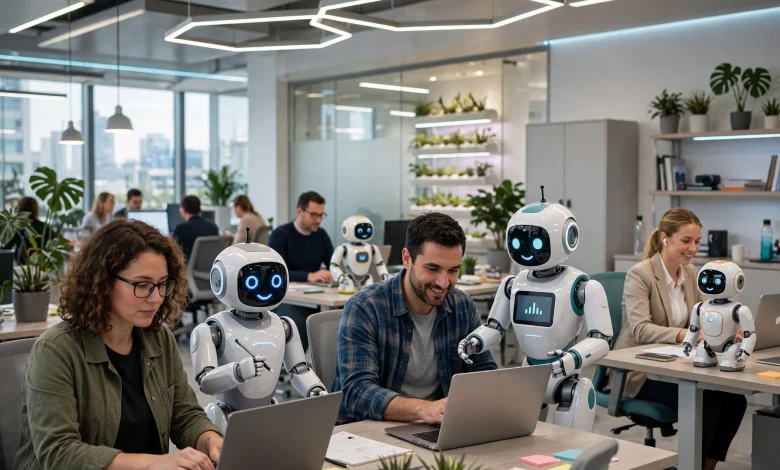
Not long ago, artificial intelligence at work meant a chatbot in the corner of a screen. In 2026, it increasingly means an AI agent: a system that does not just answer questions but completes whole tasks on its own — booking meetings, reconciling spreadsheets, drafting reports and following up with clients while you focus on something else.
The shift has been fast. Research covered by MIT Technology Review shows companies moving from pilot projects to company-wide rollouts, with agents handling the repetitive middle of the working day: the status updates, the data entry, the first drafts and the endless scheduling emails.
What AI agents actually do all day
Unlike a simple chatbot, an agent works through a goal step by step. Give it a target — “prepare the monthly sales summary” — and it will pull figures from different systems, spot anomalies, build charts and write the narrative around them. Stanford’s AI Index, published at aiindex.stanford.edu, has tracked this jump in organisational adoption year after year.
In practice, the busiest agents in 2026 handle inbox triage, meeting notes and action items, customer-support tickets, expense processing and first-pass research. If you browse our AI coverage, a pattern emerges: the winning tools are not the flashiest, but the ones that quietly remove an hour of drudgery a day.
Jobs are changing, not vanishing
The fear that agents would simply delete office jobs has not matched reality so far. Instead, roles are being unbundled. Junior analysts spend less time formatting slides and more time checking the agent’s work and talking to clients. Managers describe their job shifting from assigning tasks to reviewing outcomes — closer to editing than dictating.
That said, the pressure is real for purely routine roles. Data-entry, basic bookkeeping and tier-one support are being automated aggressively, and workers in those jobs need retraining paths, not reassurances. Companies that pair deployment with genuine upskilling are reporting the smoothest transitions.
The trust problem
Agents still make confident mistakes. A hallucinated figure in a board report or an email sent to the wrong client can erase months of productivity gains in an afternoon. That is why most successful rollouts keep a human checkpoint on anything that leaves the building or moves money.
Security teams are also adapting. An agent with access to email, files and calendars is a powerful — and attractive — target, so permissions are being tightened and every action logged. Our homepage regularly covers the guardrails companies are putting in place as agents gain more autonomy.
What comes next
The next wave is already visible: agents that talk to other agents. A procurement agent negotiating delivery slots with a supplier’s agent, or a travel agent rebooking a whole team’s itinerary after a cancellation, without a human touching a keyboard. Offices that learn to manage this digital workforce early will hold a real advantage.
How to work with your new digital colleagues
Practical experience from early adopters suggests a few rules. Start with low-stakes, easily checked tasks — summaries, drafts, data cleaning — and grade the agent like a new hire. Write instructions the way you would for a bright intern: context first, the exact output format, and what “done” looks like. Vague briefs produce vague work, from humans and machines alike.
Keep ownership clear. The professional who sends the report still owns its accuracy, which means verification habits matter more, not less, in an agent-assisted office. Teams that build checking into the workflow — a second pair of eyes on numbers, a quick source test on claims — report far fewer embarrassing errors than teams that treat output as finished product.
Finally, expect the toolset to keep changing. The agent that drafts your emails this quarter may be negotiating with suppliers next year, so the durable skill is not mastering one product. It is learning how to delegate clearly, review critically and take responsibility for the result — the same skills, it turns out, that have always defined good knowledge work.
The office of 2026 has not emptied out. But it has gained a tireless new colleague — one that never sleeps, occasionally errs, and is quietly taking over the work nobody wanted to do anyway.